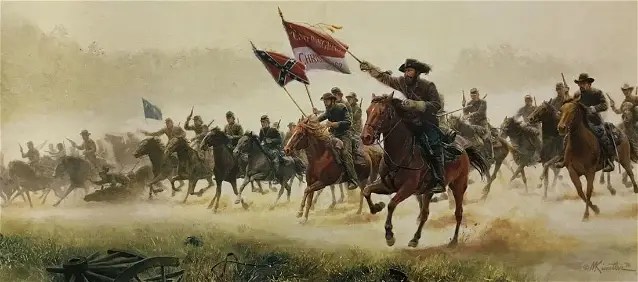
On rare occasions, battlefield heroics catapult relatively obscure nobodies into stardom and celebrity. On rarer occasions, the hero performs his deeds with such theatrical flair that both national and international audiences know not just his exploits but the personality in which he performed them.
J.E.B Stuart’s early Civil War experience can be characterized by a single word: whiplash. In early 1861, Stuart wasn’t a household name, just another gentleman officer from the great state of Virginia. By 1863, however, Stuart was the darling of the Confederacy, a shining star wished upon by millions of independence-seeking Southerners, and perhaps only outshone by Stonewall Jackson and General Lee himself. The catalyst for Stuart’s sudden stardom was his ride around McClellan.
In March 1862, US General George B. McClellan landed 121,500 men and equipment by boat on the Virginia Peninsula and moved inland to capture the Confederate capital of Richmond. Union forces were met with stiff Southern resistance, and after a series of intense battles, the bluecoats were forced into a defensive posture.
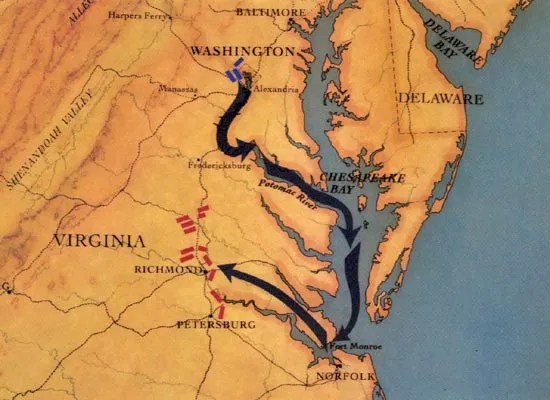
On June 10, 1862, General Robert E. Lee, eager to go on the offensive against the perpetually cautious McClellan, ordered Brigadier General J.E.B. Stuart to lead a cavalry reconnaissance mission to determine the strength of McClellan’s right flank that Lee heard was “up in the air” or unguarded by natural obstacles and vulnerable to attack.
Lee ordered Stuart “to make a secret movement to the rear of the enemy, now posted on Chickahominy, with a view of gaining intelligence of his operations, communications, &c; of driving in his foraging parties, and securing such grain, cattle, &c, for ourselves as you can make arrangements to have driven in.” Stuart was to return to Confederate lines “as soon as the object of your expedition is accomplished, making sure not to hazard unnecessarily your command or to attempt what your judgment may not approve; but be content to accomplish all the good you can without feeling it necessary to obtain all that might be desired.”
Stuart had other ideas, however, that would satisfy both Gen. Lee’s need for information and his own for glory. Stuart decided that after maneuvering behind and reconnoitering the Federal right, he would continue moving around the enemy flank and completely encircle the massive Federal army. Lee had not prohibited Stuart from making such a move, and Stuart guessed that the Federals would not be ready for such bold action. He was right. Stuart’s default aggressive action, which paired so well with Gen. Lee’s philosophy of war, pushed the Yankees even more on their heels and locked their main force into position.
Riding with Stuart were 1,200 cavalrymen, handpicked from the best stable of cavalry forces since perhaps knights graced the battlefield, and they acted like it. Stuart’s cavalry was much like Stuart himself: flamboyant, debonair, and daring, galloping into battle with a swagger and skill their Northern cavalry counterparts wouldn’t be able to match for a few years. This elite force, headed by Colonels William H.F. “Rooney” Lee (Lee’s second son) and Fitzhugh Lee (Lee’s nephew), set out in the early morning darkness of June 12th, when Stuart gave the order: “Gentlemen, in 10 minutes every man must be in his saddle.”
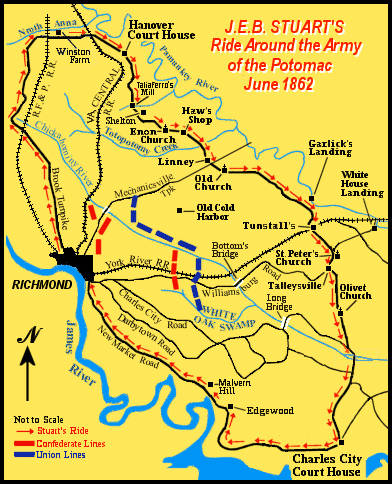
Stuart’s troopers assembled at Kilby’s Station and headed out of Richmond in a half-mile-long column, crossing the Richmond, Fredericksburg & Potomac Railroad. Moving northwest, Stuart knew the daring ride needed deception to be successful, so he devised a plan to fool Federal scouts into believing they were en route to reinforce Major General Thomas J. “Stonewall” Jackson in the Shenandoah Valley. The Southern knights rode 22 miles and crossed the Chickahominy River before turning sharply east, driving off small Federal patrols along the way. Stuart’s movement in force was facilitated by the Union’s command structure, which spread out their cavalry units, making it impossible to quickly confront such a large force. Stuart and his men successfully fooled the Federals and bivouacked at Winston Farm for the night.
The next morning, Stuart rode towards Hanover Courthouse, and once there, they found a Federal force of about 150 cavalrymen who quickly mounted their horses and dashed towards safety. The daring raiders were now discovered, so they rapidly advanced down the road to Old Church. While en route, Gen. Stuart and his escort were engaged by Union pickets and cavalry near Haw’s Shop. In standard Stuart fashion, he yelled to his personal guard above the gunfire, “Form fours! And charge!” The mounted rebels pursued their game with shouts and yells, killing and capturing a number of the enemy. The chase continued until they reached a small stream named Totopotomoy Creek.
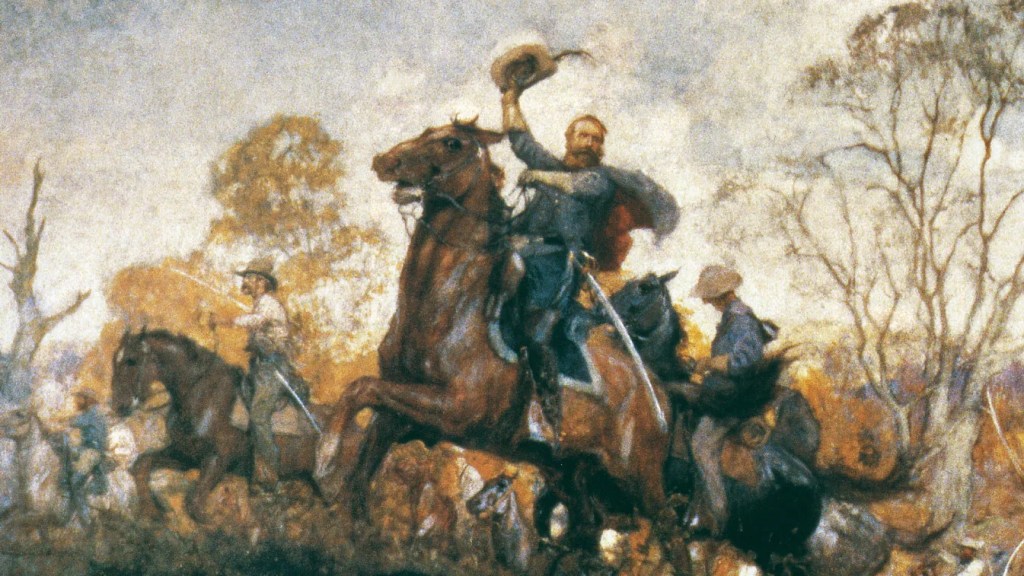
Stuart’s men rode on to attack a Union supply depot and camp near Old Church, severing telegraph lines along the way. The spoils of their conquest included large supplies of boots, pistols, liquors, and commodities; much-needed horses that were conscripted into Confederate service, and the supplies the riders couldn’t carry away with them were burned on the spot.
Stuart accomplished his mission and could return to General Lee and report as such. However, Stuart and his men were now firmly in the heart of enemy territory, so much so that they rode within eyesight of the white tents of Gen. McClellan’s headquarters. Even if he wanted to, Stuart couldn’t regress on the route in which he came because the alarm had been sounded, and an overwhelming force of Union infantry, cavalry, and artillery was bearing down on them, rapidly advancing to intercept and end the raider’s gallant expedition.
That suited Stuart just fine, as an early withdrawal had never been his plan. Stuart was asked by one of his officers if they got into a tight place, would they surrender? Stuart replied “No,…..one other course was left…..To die game.”
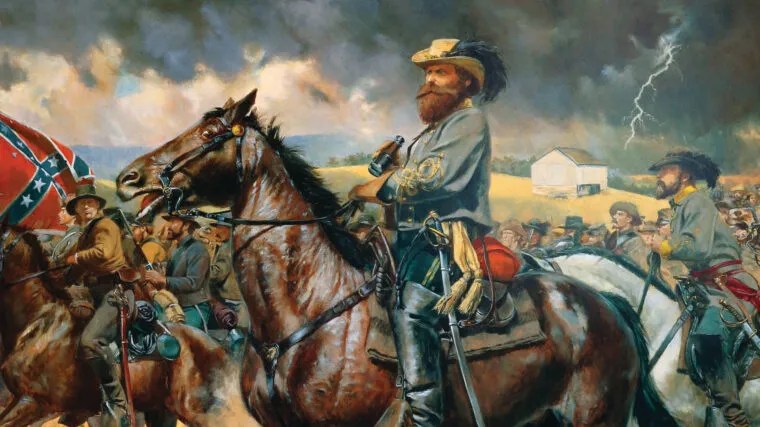
Gen. Stuart and his men pressed forward at a blistering pace as they continued their ride around McClellan, refusing to stop and rest. They traveled throughout the night, and at dawn, they arrived at the Chickahominy River, where a barn was hastily torn down to rebuild an old bridge in a race between capture and failure and triumphant success and glory. Construction took three hours, but when the final nail was driven into the bridge, Stuart and his men crossed not just the river, but into friendly territory, as well, once the Confederates continued East through Charles City Courthouse and Malvern Hill.
On June 15, three days after their first steps towards glory and history, J.E.B. Stuart and his exhausted men and steeds triumphantly arrived in Richmond, and Gen Stuart personally reported to Gen. Lee on his successful three-day ride around Gen. McClellan’s massive army.
Stuart’s 150-mile ride around McClellan provided Gen. Lee with invaluable information on terrain and Federal troop dispositions and conditions; while wreaking havoc on the Federal side by cutting communication lines, confiscating supplies, weapons, equipment, horses, capturing 180 Union soldiers, and causing widespread panic and confusion behind Union lines.
The entire expedition was highly embarrassing for General George McClellan. Northern newspapers featured the debacle as front-page news, and President Lincoln was mad with rage. Southern papers cheered the daring exploit, and a new Southern star was born and twinkled in the sky and hearts of Southerners everywhere.
 The Cavalier's Quill